| nearby sites | | Nine Stones Close | Stone Circle, 6.6km, SK225625 |
| Doll Tor | Stone Circle, 7.8km, SK238628 |
| Five Wells | Dolmen, 8.3km, SK124711 |
| Nine Ladies | Stone Circle, 8.7km |
| Stanton Moor IV | Stone Circle, 8.7km, SK247629 |
| Stanton Moor III | Stone Circle, 8.8km, SK248633 |
| Stanton Moor I | Stone Circle, 8.9km, SK249637 |
| Park Gate | Stone Circle, 13.1km, SK281685 |
| Gibbet Moor | Stone Circle, 13.8km, SK281703 |
| Gibbet Moor N | Stone Circle, 14.2km, SK282708 |
| Stoke Flat | Stone Circle, 15.9km |
| Wet Withens | Stone Circle, 16.6km, SK225789 |
| Eyam Moor III | Stone Circle, 16.8km, SK232788 |
| Bullring | Stone Circle, 16.8km, SK078783 |
| Barbrook I | Stone Circle, 16.9km, SK279756 |
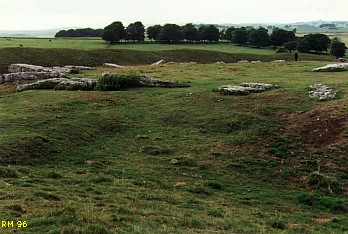
| All the stones lie
tragically prone in this 40m diameter circle-henge, nearly hidden
on its approach until you get close, then appearing in all its
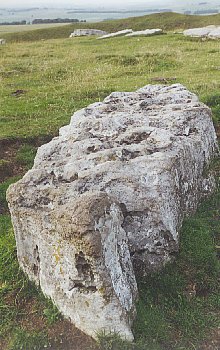
majesty. The 42 stones themselves are of limestone, weathered
into fantastic shapes by the passing millennia.
Normally Neolithic builders used more hard-wearing stone, but
limestone does wear into the most amazing gnarled shapes with the
passing of the ages. The Rollright
Stones near Oxford are made of a similar kind of stone, also
weathered into marvellous shapes.
The English Heritage board by the site has an artist's
impression of what it originally looked like. This and the text
(as of 1996) is shown below -
Welcome
to Arbor Low, one of the most important prehistoric
monuments of Britain
This has been a
special place for local people for over 4500 years, but
because of the time which has elapsed since it was built,
we can only guess at the many kinds of activities which
took place in and around its stones and earthworks.
The monument was
started in the Neolithic period, probably between 3,000
and 2,500 BC. The main illustration (below) shows
whatwhat the henge monument and stone circle might have
looked like around 2,000 BC, when all the features
visible today had been completed. Arbor Low was a place
of great significance to the local population. Its
building was a considerable feat of organisational and
engineering skill, carried out over many years.
We know that only
the simplest of tools, such as antler picks and animal
shoulder-blade shovels were used in its construction.
|

|
| The
stone circle and central setting of locally quarried
limestone were originally set upright. They would not
have been visible from outside the enclosing henge bank,
adding an air of mystery to the rituals and ceremonies
that took place inside, which only those taking part
could witness. It may have been used for for meetings of
tribespeople at impotant seasons of the year, or for
special events. While they were encamped round the
monument for these celebrations, other activities could
have included the trading of goods or crops, as well as
the exchange fo information.
Superimposed on the
south east bank of the henge is a later Bronze Age burial
mound whinc, when excavated in the 19th centruy revealed
a burial with two crudely made urns and a bone pin.
About 250 yards to
the south west of Arbor Low is Gib Hill, another Bronze
Age burial mound and one of the most imposing in the Peak
[District of England]. It is built above one end of an
earlier Neolithic long barrow which was probably
constructed several hundred years before Arbor Low as the
original ritual focus of this ridgetop.
|
|